
GMA Pallets Explained: The 48×40 Standard and Why It Matters
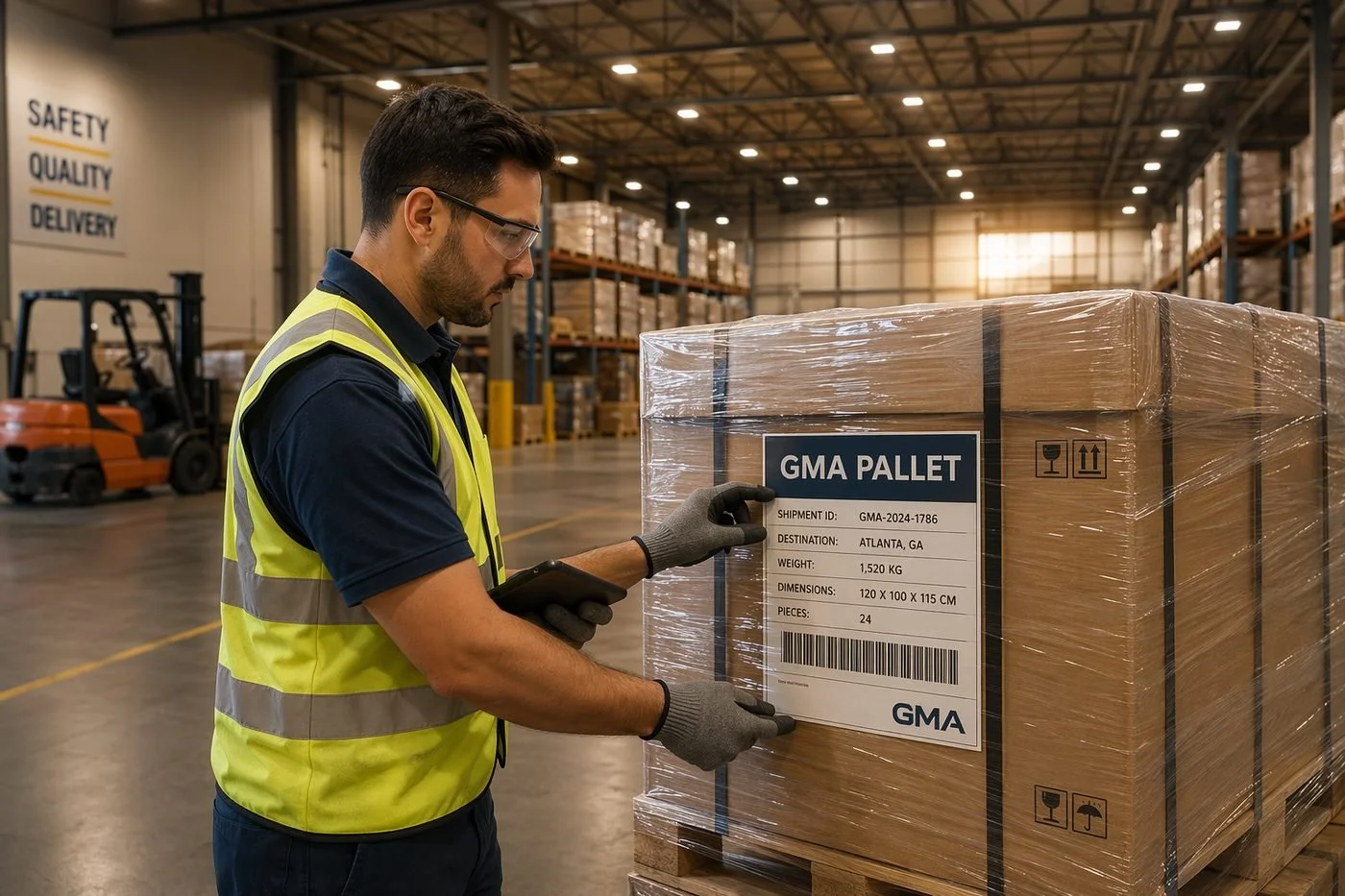
If you work in shipping, storage, or retail, you have almost certainly loaded a truck with GMA pallets without giving them a second thought. They are one of the quiet workhorses behind a smooth supply chain, especially for food and consumer goods. Their whole value comes from being predictable. When the size, build, and handling stay the same load after load, your operation gets easier to run. That is why this format has stayed the go-to choice for moving product across busy U.S. networks for decades.

What is a GMA pallet?
A GMA pallet is a wooden pallet built to guidelines first set by the Grocery Manufacturers Association. It caught on because businesses needed one reliable size they could count on from the plant floor to the store back room.
You will find these pallets in grocery stores, factories, and distribution centers all over the country. The shared design lets forklifts, pallet jacks, trailers, and racking all work together with fewer hiccups. That common size is a big reason it became the most widely used pallet in North America.
A little history
The Grocery Manufacturers Association, now known as the Consumer Brands Association after a 2020 rebrand, introduced the format to bring some order to food industry shipping. Before that, companies used all kinds of pallet sizes, which meant delays, wasted space, and banged-up freight.
The industry needed a common platform that would work from production all the way to store delivery. A single dependable size gave manufacturers, truckers, and retailers something they could all plan around. Over time the 48 by 40 footprint became the North American standard, and it stays closely tied to grocery and consumer goods today.
Its role in the U.S. supply chain
In the United States, this size matters because so much equipment is built around it. When one pallet moves cleanly through trucks, warehouses, and store back rooms, your whole operation gets easier to plan. Here is where you feel it day to day:
- Smoother loading and unloading at distribution centers.
- Products arriving at stores in a familiar, easy-to-handle format.
- A footprint that fits equipment and layouts already designed for it.
- Less time lost wrestling with odd sizes.
The 48 by 40 footprint also plays nicely with standard trailers and common warehouse practices. That is exactly why it became the default. It is a simple, proven way to connect shipping, storage, and retail without adding headaches.
Standard dimensions and specs
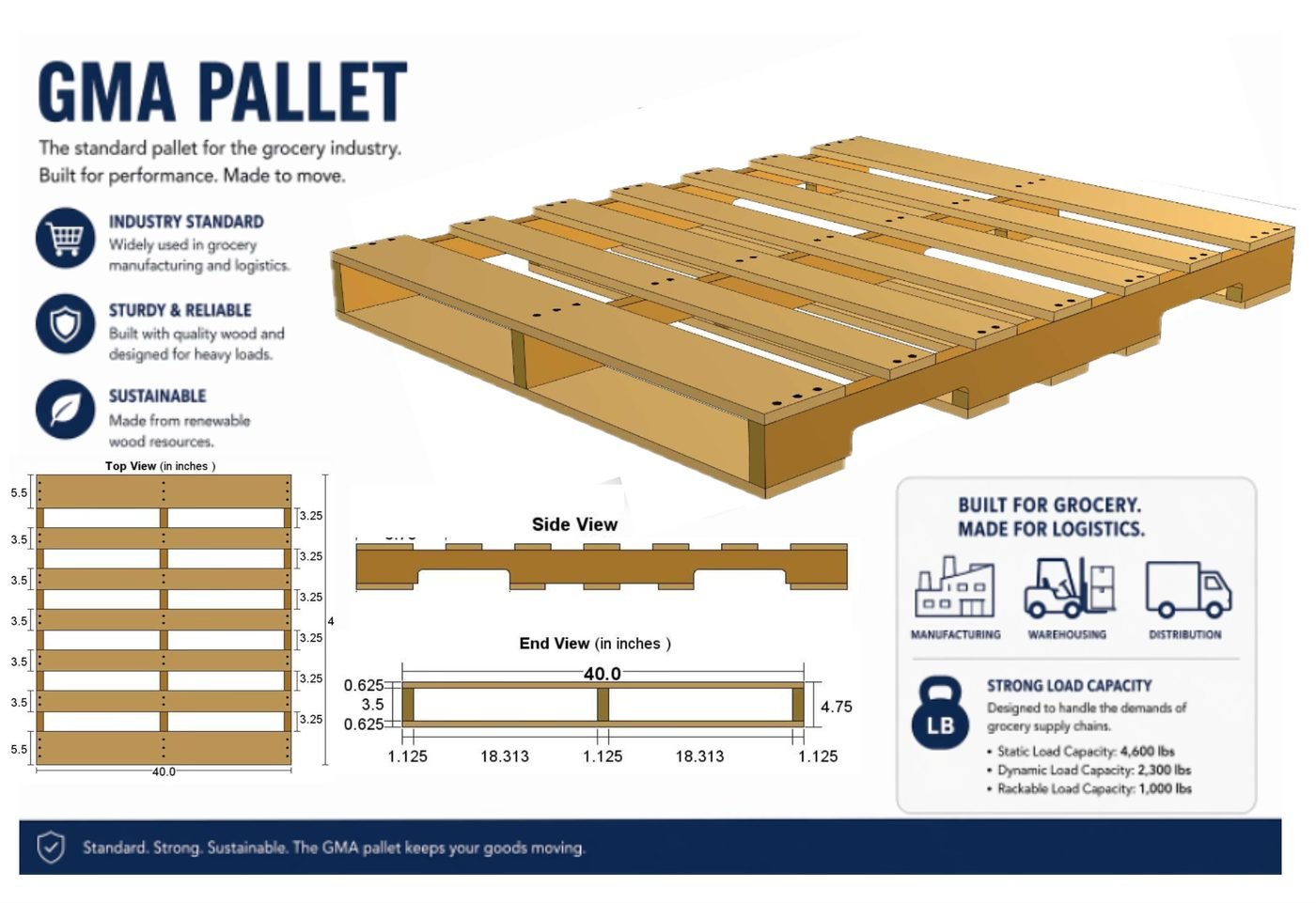
When people say GMA pallet, they usually mean one specific size: 48 inches long by 40 inches wide. It is one of the best-known pallet sizes in North America. But the footprint is only part of the story. The board layout, forklift entry, and load performance all matter too. Here are the key numbers in one place.
| Specification | Standard GMA 48x40 detail |
|---|---|
| Footprint | 48 inches long by 40 inches wide |
| Stringers | Three, with two notches per side for four-way entry |
| Top deck boards | Seven: a wider board on each end, five narrower boards in the center |
| Bottom deck boards | Five: end boards plus three inner boards |
| Empty weight | Roughly 30 to 48 pounds, depending on wood and moisture |
| Dynamic load (in motion) | 2,300 to 2,800 pounds on a forklift or pallet jack, depending on grade |
| Rackable load (on beams) | Commonly 1,000 to 2,800 pounds, depending on grade and support |
| Static load (on the floor) | Up to roughly 30,000 pounds when stacked and stationary |
| Forklift entry | Four-way (notched) for faster handling |
Exact measurements and load capacity
A standard GMA pallet is 48 by 40 inches with three stringers, seven top deck boards, and five bottom deck boards. Two notches on each side allow four-way forklift entry, which speeds up handling in a busy dock.
On weight, the numbers vary quite a bit by grade and condition, so it helps to think in ranges. In motion, meaning while a forklift or pallet jack is carrying it, a typical GMA pallet handles roughly 2,300 to 2,800 pounds. On warehouse beam racking the working figure is usually lower, commonly 1,000 to 2,800 pounds. Sitting still on the floor, a sound pallet can hold far more, with figures up to around 30,000 pounds cited for stacked storage. Because ratings move with the grade and build, many warehouse crews plan around a conservative working limit to leave room for wear. The takeaway is simple: a solid GMA pallet is built for everyday shipping and storage with strength to spare.
Who sets the rules
The original specs came from the Grocery Manufacturers Association, now the Consumer Brands Association. The goal was one standard that food and consumer goods companies could trust across transport, storage, and distribution.
The spec covers more than the outside size. It includes the board layout, load capacity, and forklift access. The top uses a wider board on each end with five narrower boards in the middle. The bottom follows a similar pattern with end boards and three inner boards between the notches. All of that consistency is the point. When suppliers, warehouses, and retailers use the same baseline, equipment fits together and confusion drops.
What GMA pallets are made of
GMA pallets are most often wood. In a lot of operations, wooden pallets stay the default because they are familiar, easy to find, and line up with long-standing grading standards. You will see them in shipping, warehousing, and store delivery every day.
Plastic is becoming more common in food settings, though. The two materials suit different needs. Some buyers focus on lower upfront cost, others want easy cleaning and a longer service life. Looking at both helps you pick the right fit.
Wood, the usual choice
Wood is the material most people picture with a GMA pallet. New ones are often built from hardwood or pine depending on what is available and how they will be used. Recycled wooden pallets are common too, and grading tells buyers what shape they are in. Here is a quick look at the grades we supply.
Number 1
(Grade A) Premium, like newTop quality. Ready to run.
- Our highest quality recycled 48x40 GMA pallets.
- Have not been repaired.
- Clean, uniform look with only minor wear.
- Meet the leading grading standards used across grocery and consumer goods.
- A strong fit for retail displays and any load a customer will see.
Number 2
(Grade B) Solid, repairedDependable value for everyday shipping.
- Sound, reliable pallets at a lower cost than Number 1.
- Have had stringers or deck boards replaced.
- More visible wear than a Number 1.
- A common pick for shipping and warehousing where appearance matters less.
Grade C
Needs repairNot ready to use yet.
- Broken pallets.
- Need to be repaired before they can be used.
Plastic, the newer option
Plastic pallets are available in GMA-style dimensions, even though the original grading was built around wood. In food and beverage, they are getting more attention because they offer things wood does not always match. Compared with wood, plastic tends to:
- Hold up to frequent washdowns in food environments.
- Last longer and need fewer repairs.
- Earn back a higher upfront cost over many trips.
Wood still wins for buyers who want the lower starting price, and it is easy to repair or recycle. Plastic can pull ahead over time because it does not need fixing as often. Metal pallets exist for heavy-duty niches, but for GMA-style work the real choice is usually wood versus plastic.
Key benefits of using GMA pallets
A GMA pallet stands out because it pairs a proven size with a build made for everyday logistics. As the standard, it gives you a reliable way to load, store, and move goods through systems built around one shared format. That consistency cuts product damage and supports better structural strength during handling. It also fits common trailers, warehouse layouts, and lifting equipment without special adjustments.
Shipping efficiency and cost
One big reason companies stick with GMA pallets is shipping efficiency. A standard size makes planning easier because loads fit the same way every time, which helps you use trailer space well and cut down on wasted room. It also smooths out the warehouse side:
- Fits common trailer and racking systems with little fuss.
- Makes stacking and moving freight more predictable.
- Trims the extra costs that come with odd sizes and rehandling.
As a rule of thumb, about 26 GMA pallets fit on the floor of a 53-foot trailer in a single layer, and roughly double that when you can safely stack them. Better use of space means lower freight costs, safer stacking, and fewer slowdowns across the board.
Food and safety considerations
In the food world, consistency is not just convenient, it supports your compliance efforts. The GMA guidelines were built with food handling in mind, so they create a predictable format for transport, storage, and handling where cleanliness and safety count. Grade plays a role here too. Cleaner Grade A pallets often show up in store displays where customers can see them, while lower grades stay in back-end shipping and warehousing.
That does not make every pallet automatically compliant with every rule. If you ship internationally, for example, your wood pallets may need heat treatment under the ISPM-15 standard. Still, the GMA format remains the benchmark because it lines the pallet design up with the real needs of food and safety handling.
How GMA pallets compare to other types
Not every pallet works the same way. A GMA pallet is built around a fixed U.S. standard, while other formats serve different regions, loads, or handling systems. Block pallets, Euro pallets, and custom builds all have their place, but they do not always match U.S. equipment and racking as cleanly. Here is a quick side-by-side.
| Pallet type | Typical size | Best fit |
|---|---|---|
| GMA (stringer) | 48 x 40 inches | U.S. supply chains, grocery and consumer goods, standard trailers and racking |
| Euro (EPAL) | 47.2 x 31.5 inches (1200 x 800 mm) | European shipping lanes and equipment |
| Block | Various, often 48 x 40 inches | Heavier loads and true four-way entry from all sides |
| Custom | Built to spec | Odd-sized products or special handling needs |
The short version
The main difference between a GMA pallet and the others usually comes down to size and compatibility. In the U.S., the 48 by 40 format fits common trailers, racks, and handling systems out of the box. Euro and custom pallets can be the right call in special cases, but if your operation is based in the States, the GMA pallet usually gives you the best mix of availability, cost, and equipment fit.
Bottom line
Understanding GMA pallets helps you run a tighter supply chain and stay aligned with the standards your partners already use. They bring real advantages: better shipping efficiency, dependable handling, and a size that fits the equipment you already own. Whether you are in manufacturing, distribution, or retail, building your operation around this proven format takes a lot of guesswork out of moving product.
Not sure which pallet fits your load?
Atlas Pallets & Packaging is a Midwest pallet and packaging supplier based in Warrenville, Illinois, right in the middle of the Chicago freight market. Tell us what you are shipping and we will help you land on the right size, grade, and material, then get you a quote.
Call or text: 630-765-5476 | Email: atlaspalletsllc@gmail.com