
Corrugated Boxes: Type, Strength, and How to Choose the Right One
Single, double, and triple wall. Flute grades, box strength ratings, and the common styles. What each one is for and when to pay for more box.

A corrugated box is not just a cardboard box. What it is made of decides whether your product shows up clean or crushed, and whether you are paying for strength you do not need. This page walks through the pieces that matter when you order: how the board is built, how strength is rated, and the common box styles. If you know what your product weighs and how it ships, you will be able to spec a box with confidence by the end.
How a corrugated box is built
Corrugated board is three layers: a wavy inner layer called the flute, sandwiched between two flat sheets called liners. The flute is what gives the board its stiffness and its cushioning. Add more layers of flute and liner and you get a stronger wall. That is the difference between single, double, and triple wall board.

Single wall
One layer of flute between two liners. The everyday box. Right for most light to medium products moving through parcel or on a palletized load that is not stacked high.
Double wall
Two layers of flute. Noticeably stiffer and better at resisting a crush from above. This is where you go for heavier products, for boxes that get stacked, and for anything that has to survive a rougher freight ride.
Triple wall
Three layers of flute. Nearly a wooden crate in strength. Used for very heavy or industrial items and for boxes big enough to sit on the floor and take weight on top. If you are reaching for triple wall, it is worth a quick call to check whether a box or a crate is the better answer.
Flute grades (the size of the wave)
Flutes come in sizes, labeled with letters. Bigger flutes cushion better and add stacking strength. Smaller flutes give a flatter surface for printing and take up less space. You do not have to memorize these, but it helps to know they exist when we talk through a box.
- A-flute: the tallest common flute. Best cushioning and stacking strength.
- C-flute: the most common all-purpose flute. A good middle ground and what most shipping boxes use.
- B-flute: shorter flute, flatter and firmer wall. Good for boxes that need a solid surface and decent puncture resistance.
- E-flute and F-flute: thin flutes used for retail-style and small product boxes where a smooth print surface matters more than heavy cushioning.
How box strength is rated
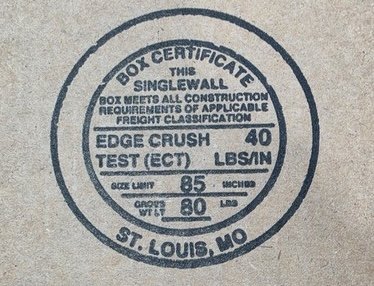
Two ratings show up on the box maker's stamp, and knowing which one you are buying to keeps you from over or under ordering.
Edge Crush Test (ECT)
Measures how much stacking weight the board's edges can take before crushing. This is the number that matters most for palletized loads and for anything stacked in a warehouse. Higher ECT means more boxes can sit on top before the bottom one gives.
Burst strength (Mullen test)
Measures how much pressure the board takes before it punctures. This matters more for rough handling and for heavier single items that could poke through a wall. Older box specs are written this way.
For most palletized freight, spec to ECT. For rough-handled or heavy single-item shipments, burst strength earns its keep. If you are not sure which your product needs, that is exactly the kind of thing to hand to us with a photo of the load.
Common box styles
- Regular Slotted Container (RSC): the standard box where all flaps are the same length and the outer flaps meet in the middle. The default for a reason and the most economical.
- Full Overlap (FOL): outer flaps overlap the full width for extra stacking strength and edge protection. Good for heavy products.
- Half Slotted Container (HSC): like an RSC with no top flaps, often used with a separate lid or for parts bins.
- Die-cut and custom: a box cut to your exact product so it needs less void fill and less tape. Worth it when you ship the same item over and over.
Stock or custom?
Stock boxes cover most needs and ship fast. Spec a custom box when you are shipping the same product in volume and a snug fit would cut your void fill, your damage rate, or your dimensional shipping charges. If you find yourself filling half of every box with paper, that is the signal to price a custom size.

Frequently asked questions
Do I need single wall or double wall?
Single wall handles most light to medium products and pallet loads that are not stacked high. Move up to double wall for heavier products, boxes that get stacked, or a rougher freight ride. If you are between the two, send the weight and how it ships and we will spec it.
What is the difference between ECT and burst strength?
ECT (edge crush test) measures stacking strength, how much weight the box can take on top. Burst strength measures how much pressure the wall takes before it punctures. Spec to ECT for palletized loads, and to burst strength for rough handling or heavy single items.
How do I know what box strength to order?
It comes down to three things: the product weight, how high the boxes stack, and how rough the ride is. Rather than guess, send those three with a photo of the load and we will match the board.
When is a custom box worth it over a stock box?
When you ship the same product in volume and a snug fit would cut your void fill, your damage rate, or your dimensional shipping charges. If you are filling half of every box with paper, it is time to price a custom size.
Can Atlas match a box I already buy?
In most cases, yes. Send the current box dimensions, the board grade if you have it, or just a sample, and we will quote the equivalent and size it to your product.
Send us the product, the weight, and how it ships. We will spec a box that protects it without paying for board you do not need, and quote it to your volume.
Get a Box Quote →