
Custom Wood Crates Built for Your Shipment
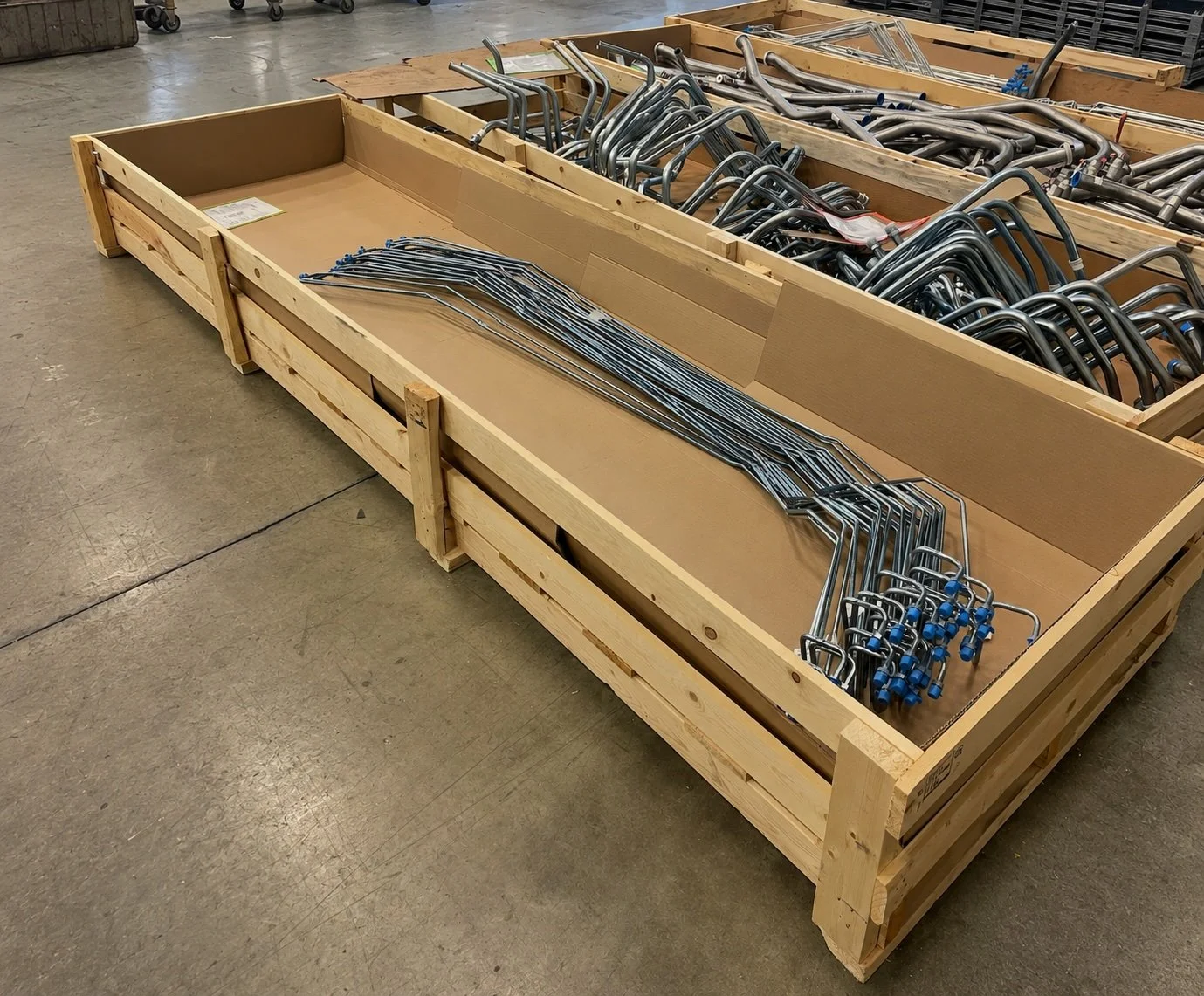
If your product is too fragile, too oddly shaped, or going overseas, a pallet plus stretch wrap is not enough. Atlas builds crates that survive the route, satisfy customs, and protect the equipment inside.
Twelve. That is the number of distinct heat-treated export crate sizes Atlas has built into a working library for one national steel and specialty-alloy distributor. 158 inches long. 84 inches long. 49 by 40. 39 by 33. 32 by 27. Vertical-product crates with lids. The buyer does not re-engineer a crate every time a shipment leaves the dock. They pick the size from the library and we build it.
On top of that, the same customer gets roughly 1,800 notched, heavy-duty winged skids for steel through Atlas. One supplier covers both the skids and the crates for everything that customer ships.
When a crate beats a pallet plus stretch wrap
A standard 48 by 40 pallet wrapped in stretch film is plenty for most domestic loads. But when the product is fragile, irregularly shaped, going overseas, or going to a customer who has their own packaging spec, the right answer is a crate. Atlas builds wood crates every week for buyers across the Midwest who hit one of these three triggers.
- Fragility. The product will not survive a freight handler's lift truck or a customs inspection wrapped on an open pallet. Process instrumentation, finished tooling, marble and stone slabs, sensitive equipment.
- Irregular shape. The product is tall, narrow, asymmetric, or has hardware sticking out that needs an enclosure. Steel coils on edge, hose assemblies, vertical equipment housings, machinery with brackets.
- International destination. Wood packaging crossing a border has to be heat-treated and stamped to the ISPM-15 standard, or customs at the destination port will not release the freight. Stretch wrap does not solve this. A heat-treated crate does.
Heat-treated export crates: the ISPM-15 piece
If wood packaging is crossing a border, it has to be heat-treated to 133 degrees Fahrenheit at the wood's core for 30 minutes and stamped with the IPPC mark. The stamp is what customs looks for. No stamp means the freight sits at the destination port and the shipper deals with the consequences.
Every export crate from Atlas is heat-treated, with the IPPC stamp on at least two opposite faces. The treatment kills any pests in the wood and spoils the fibers that attract them in the first place. It does not waterproof the wood and it does not change the structural strength.
How Atlas runs heat treatment
A crate only has to hold temperature for 30 minutes, but getting the core of every board up to heat takes hours. The usual plan is to load the oven at the end of the day and run it overnight, so heat treatment adds about a day to the lead time. We tell you that up front.
The long-and-narrow export library
The export crate library Atlas built for a national steel and specialty-alloy distributor covers four 158-inch sizes (12 by 12, 9 by 9, 7 by 7, 5 by 5) and four 84-inch sizes in the same cross-sections, plus 289-inch one-offs for the long bars and tubing. Matching the cross-section to the product diameter keeps wasted volume off the freight invoice.
Domestic custom crates
Not every crate goes overseas. About half of Atlas's crate volume is domestic, built for buyers who need more protection than a pallet plus stretch wrap can give, or who ship to a downstream customer that will reject a load on packaging quality.
Equipment crates
A Chicago-area popcorn machine manufacturer runs three named equipment crates through Atlas, each one built around a specific machine. The crate matches the machine plus its access panels, interior bracing holds the machine centered on the deck, and a wall or lid comes off cleanly so the receiving operator does not have to break the crate to get the machine out.
A Chicago-area industrial hose manufacturer runs a reinforced, lidded crate program with Atlas across more than two hundred crates. The reinforcement is for the weight of the hose product inside, and for protection against side or top impacts in the shipping process.
Vertical-product crates with lids
When the product stands upright in the crate, the build changes. The sidewalls carry more load, the lid has to seat tight and stay tight through the trip, and the base needs a notched or winged design so a forklift can pick the crate without dragging the load. Atlas builds these in sizes including 49 by 40, 74 by 16 by 14, 32 by 27, and 39 by 33.
A-frames for tall freight
Some loads are tall enough that a flat deck plus stretch wrap will not make the trip. A-frame crates and pallets hold the product on edge with bracing on both sides. Atlas runs a 120-inch A-frame program for a Chicago-area marble slab importer (covered on the Custom Pallets page) and builds larger A-frame crates for oversize inventory.
The spec questions that shape your crate
Before Atlas quotes a custom crate, your answers to a few questions shape the build. None of them are trick questions, and you do not need all the answers before you call. The conversation usually fills in the gaps.
Plywood or OSB
Plywood is the default for export and any crate that takes hits in transit. OSB is cheaper and fine for a short domestic one-shot crate with a durable product and a single drop.
Lid or open-top
A lid protects against drop damage from above, weather during dock staging, and the handler who sets a box on top of yours. Open-top loads faster and costs less.
Notching for banding
A shallow groove in the base lets the strap pass through with a wall on either side so it cannot slip sideways.
Bracing and dunnage
Bracing holds the product off the walls and floor. A fragile instrument gets foam-lined cleats. A heavy steel coil gets dimensional lumber blocking.
Heat treatment
Domestic does not require it. International must be heat-treated and stamped to ISPM-15. Atlas handles the stamp and paperwork either way.
How Atlas runs a custom crate quote
The quote process is built to be fast and direct. You call, we ask a short set of questions, we figure the price, and we get back to you. Running lean is core to how Atlas works. You have one point of contact who handles your account every time. No ticket queue, no rep rotation, no escalation path.
What Atlas needs to quote
Six things, in this order: product weight inside the crate, product dimensions (length by width by height), destination including whether it crosses a border, lid or open-top, quantity per delivery and how often, and the delivery ZIP so freight gets priced right. If you do not know one of those, that is fine. A photo of the product on a pallet or in its current packaging is the single most useful thing you can send.
Lead time, honest answer
For most orders, even large ones, we ask for about 7 days from the approved drawing to delivery. That window covers the build queue, the heat-treat cycle when it is required, and the truck. Recurring orders can be planned ahead and ship sooner. And we know buyers tend to discover they are short on crates when there are only one or two left, so we will always try to expedite an emergency order. It does not always work out, but we will tell you exactly what the lead time looks like before you commit.
When a crate is the wrong answer
Atlas is not in the business of selling a crate when a pallet plus stretch wrap will do the job. Crates cost more, weigh more, and take up more truck space. If your product fits on a 48 by 40 pallet, weighs under about 2,500 pounds, and is going to a domestic customer with no written spec, a standard pallet is plenty.
The same goes the other way. Some loads that look like they need a wood crate actually do better in a crate built from laminated paperboard. Those are lighter and cost less per unit on a recurring program, and Atlas does that work too.
Frequently asked questions
What is the difference between a custom crate and a heat-treated crate?
A custom crate is any crate built to your spec instead of a standard catalog size. A heat-treated crate is one that has been heated to 133 degrees Fahrenheit at the core for 30 minutes and stamped with the IPPC mark. Most custom export crates are heat-treated. Most domestic crates are not, unless you ask.
Do I need a heat-treated crate if I am only shipping domestically?
No, unless a downstream customer or contract requires it. Heat treatment is an international requirement. For domestic shipments, kiln-dried or untreated lumber is fine. If you ship both domestically and internationally and do not want to risk sending the wrong crate, you can have all your crates heat-treated. The extra cost is small.
How do I know if I need a crate instead of a pallet?
If your product is fragile, irregularly shaped, or going overseas, a crate usually beats a pallet plus stretch wrap. If it can sit flat and be wrapped, a pallet is plenty. See when a pallet is the right answer.
How fast can Atlas deliver a custom crate?
About 7 days from approved drawing to first delivery, faster for scheduled recurring programs. Atlas tells you the timeline before you commit.
What is the minimum order size for a custom crate?
There is no hard minimum, but a one-off single crate carries a higher per-unit delivery cost than a full truckload.
Does Atlas handle the IPPC stamping and the export paperwork?
Yes. Every export crate ships with the IPPC stamp on at least two opposite faces and the certification paperwork in the load. If your freight forwarder needs anything extra, tell Atlas at the quote stage and we include it.
Tell us what you ship.
Send your product weight, dimensions, destination, and monthly volume. Atlas gets you a real number fast, with no run-around.
Get a Quote →